Saturday, October 15, 2011

Knitting Pattern: Off-the-shoulder Top

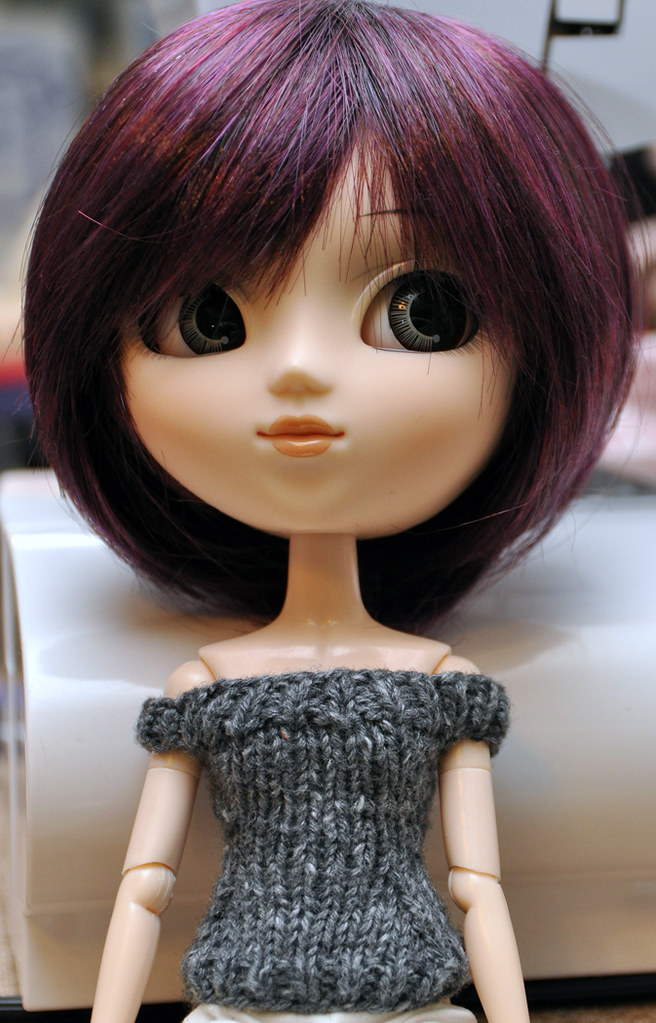
Knit entirely in the round (so no seaming! yay!), this easy-peasy top looks super cute and takes practically no time.


Off-the-shoulder Top (Short sleeves)


Materials:
  • Fingering weight yarn.  Used for model: DMC Senso Wool Cotton (70% cotton, 30% wool), color no. 1305, equivalent to size 3 crochet thread.  100% cotton is not recommended, because it knits up thick without stretch.  Try very thin sock yarn.  You will need far less than one 100 yd (29g) ball
  • Two size 1-US circular needles or a set of size 1-US DPNs.
  • Darning needle, ruler, and scissors
You will need to know:
  • How to knit in the round
  • How to work 1x1 ribbing in the round
  • How to cast on mid-way through a round
  • SSK and K2tog
  • The m1 increase
Gauge: 10.5 sts/per inch in stockinette stitch on size 1-US needles.  To ensure accurate sizing, be sure to check your gauge.
    Instructions:
    CO 36 sts.  Being careful not to twist, join for knitting in the round.  Work 3 rounds in 1x1 ribbing.


    Place marker after first 18 stitches.
    Decrease round: K1, ssk, k to last 3 sts, k2tog, k1.  Repeat for back needle.
    Work decrease round, then knit one round.  Do this four times total, until you have a total of 20 sts on the needles.


    K2 more rounds.


    Begin increase rounds to shape for ribcage.  Work the following repeat of 3 rounds three times:
    Round 1: K1, m1, k to last st, m1, k1.  Repeat for back needle.
    Rounds 2 and 3: k all sts.


    You will end this round with 32 sts.  At the end of this last round, CO 8 sts.  Continue knitting to the next marker and CO 8 more sts.  You now have 48 sts.  K to end of round.  Beginning with the newly CO sts, begin to work in 1x1 ribbing.  Work 3 total rounds in 1x1 ribbing.  BO all sts.


    Stretch the armholes with a larger knitting needle or some other implement roughly the size of a doll arm (i.e., a pinky finger).  Weave in the two ends and you’re done!

    Saturday, October 8, 2011

    Sewing Tutorial: Kindle Book Case

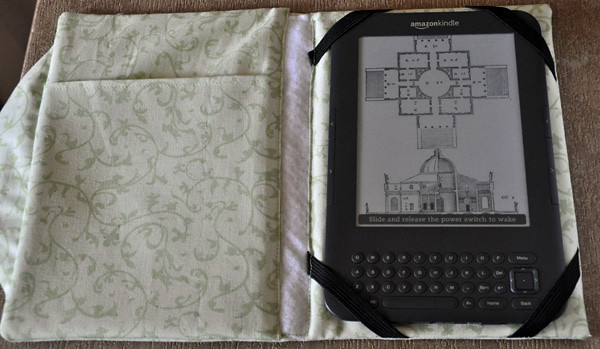
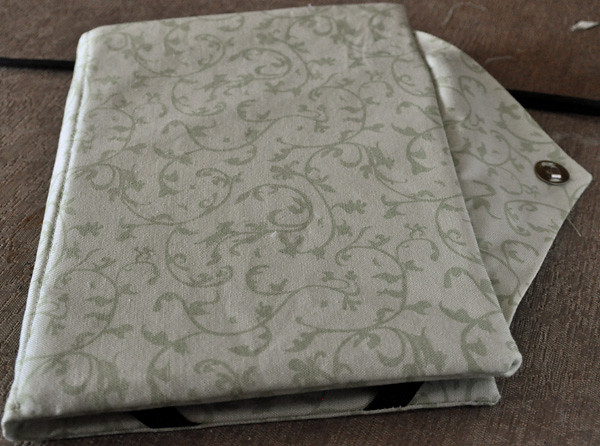
    My attempt at a "book" style cover for Kindle.  My sewing skills aren't the very best, but the geometry is correct and a neater seamstress will be able to produce better results.


    Supplies & materials:
    • Mat board OR stiff plastic canvas (if you plan on washing the piece), 2 pieces that measure 8 × 5.5”
    • Note: I cut my mat board with a fabric rotary cutter and trimmed it down with a craft knife (like an “X-Acto”). I don’t recommend using scissors on mat board; if you don’t have the necessary tools to cut it, then just use some stiff plastic canvas.
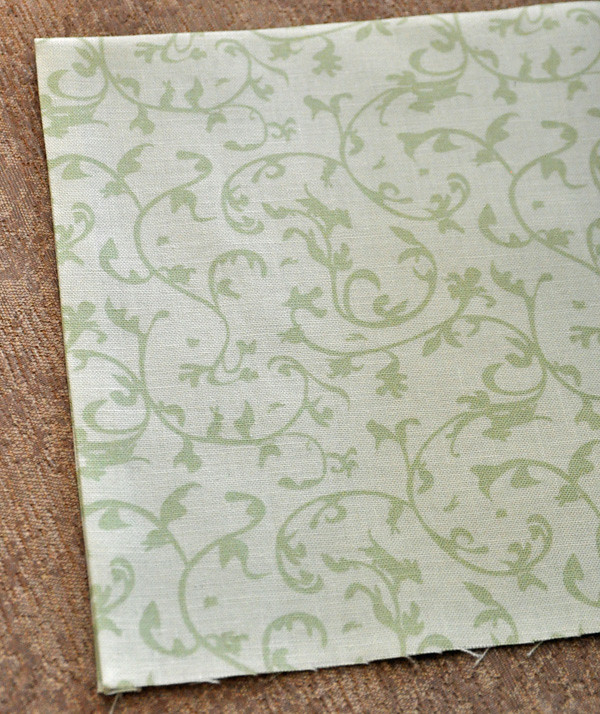
    • Fat quarter or half yard of your choice of fabric (you can use two fabrics, outer and lining, if you like). Suggested fabrics: cotton solids, calico, denim (outer fabric), PVC/"pleather" (outer fabric)
    • 12” of ¼” wide elastic
    • Sew-on snap or (weak) magnetic snap closure, hook and loop (Velcro) or button (a button will not allow you to close the “book” backwards; no big deal if you don’t care)
    • Felt or thick fabric, 2” by 9”
    • Ruler
    • Sewing machine, needle appropriate for fabric, and thread
    • Iron set to heat setting appropriate for main fabric
    NOTE: ALL SEAM ALLOWANCES SHOULD BE AS CLOSE TO ⅜ AS YOU CAN GET.  SEW SLOWLY TO ENSURE ACCURACY AND NEATNESS.

    READ ALL DIRECTIONS BEFORE YOU BEGIN.

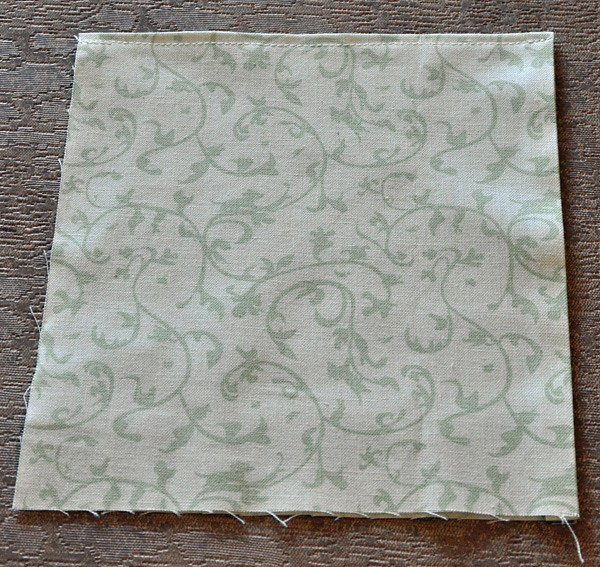
    Press your fabric and cut out your pattern pieces.
    • Outside fabric: 12 ⅝ × 9” (If you are using a different fabric for the outside, use it here. This fabric may be doubled or interfaced if desired. If you double it, baste both pieces together right side in; if you interface it, I recommend medium-weight fusible interfacing.)
    • Inside fabric (cut 2): 6 ½ × 9” (These may also be interfaced if you want. I would use lightweight fusible.) I will refer to these pieces as “inside pockets” since they will enclose the mat board/plastic canvas.
    • Inner pocket (optional) (cut 1): 13 × 6 ½” (will be folded width-wise)
    • Flap (cut 2 [outer fabric]): Cut an isosceles triangle with the base being 9” long and the height/altitude being 3”. This is most easily accomplished by folding the fabric along the altitude and cutting a triangle that is 3” along the fold and 4 ½” in a right angle from the fold, then connecting the two points via straight line. If you prefer a straight flap or other shape simply cut it to whatever dimensions/shape you like. A round flap would look nice, or you could just make a thin strap, or skip this step altogether if you have another creative idea to keep the whole thing shut.

    Diagram to cut out triangle flap.  This results in an isosceles triangle described above.
    1.      Cut 4 pieces of elastic, 3” long each.  Do not worry about cutting your felt.

     Press all pieces flat after cutting.

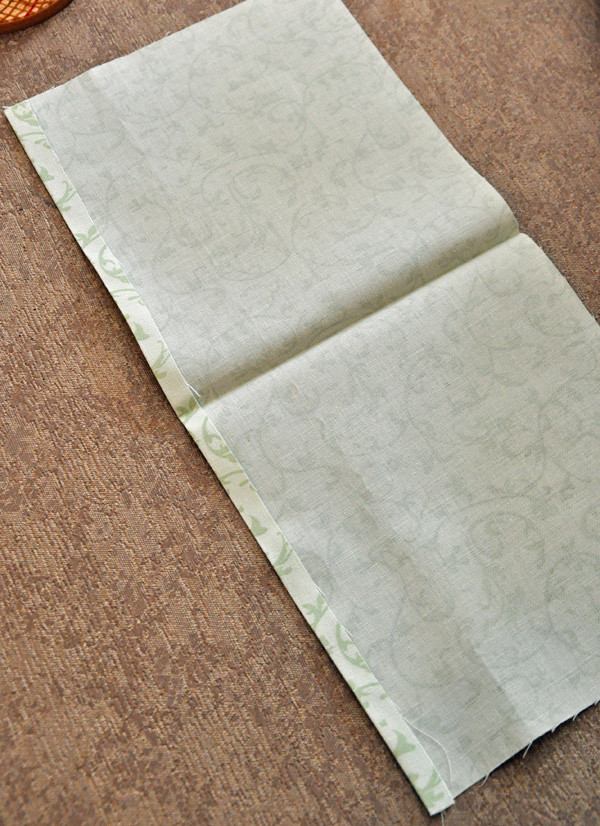
    Press one of the longer sides of the pocket piece (the 13 × 6 ½”) under about ⅜”.  

     Press it now width-wise, right sides out, so that it now measures almost 6 ½” square, ensuring that the narrow folded bit is tucked in very neatly.  

    Press in one long side of each inside pocket as close to ⅜” as you can get without burning yourself.  If you err, try not to make it wider than ½”.
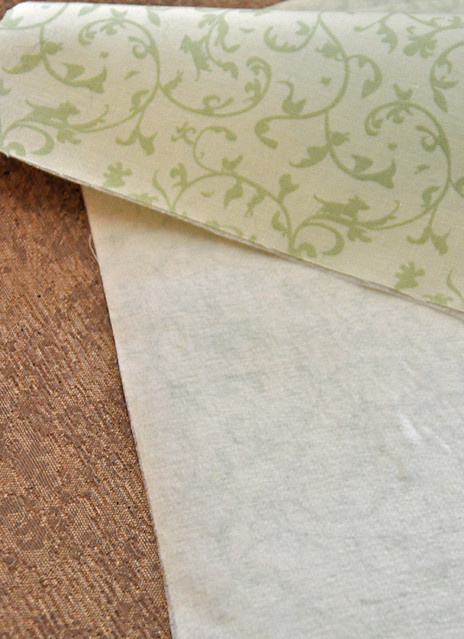
     Apply fusible interfacing if you choose to do so.

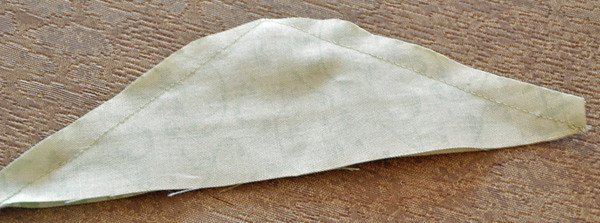
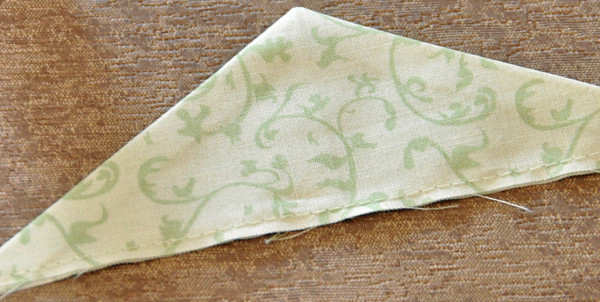
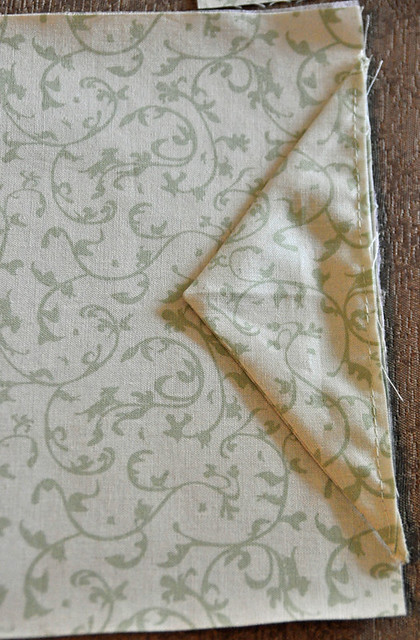
    With right sides together, stitch along the top edges of the triangle, leaving the base unstitched.  Trim the corners close to stitching and turn.   

    Press.  Baste along the raw edges of the bottom close to edge.
       
    Top stitch close to the folded edge of the inner pocket (not the hemmed edge; sew along the top that will form the top of the pocket itself).
    With right sides together, pin as follows:
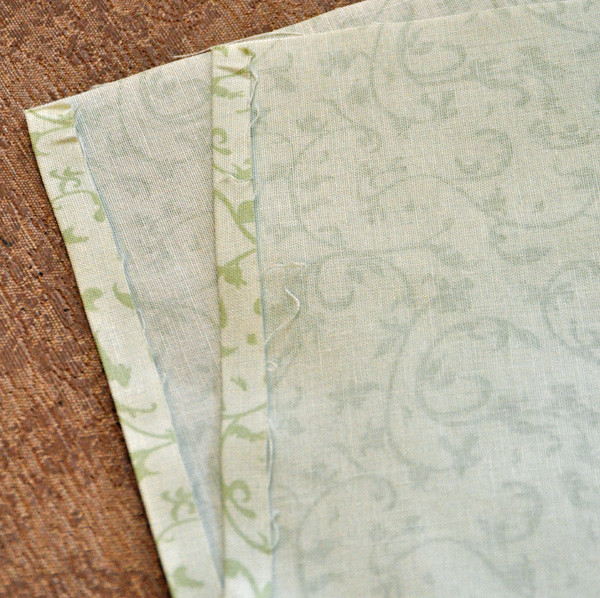
    Pin each side pocket to the main fabric, having the pressed edges closest to each other.
    Pin in the elastic, so that it will catch in the seams, across each corner of the left side pocket, which will be the right pocket when turned right side out.

    On the other pocket, sandwich inside the inside pocket the flap and inner pocket.  The order of fabrics should be:
    • Outside fabric
    • Flap
    • Inner pocket (the square piece that is folded)
    • Inside pocket (the part that will enclose the board)

    For the moment, don’t worry about the gap in between the inner pockets.  We’ll take care of that in a minute.


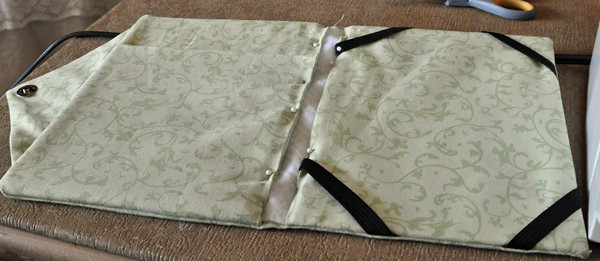
    This is what it will look like right before you stitch.

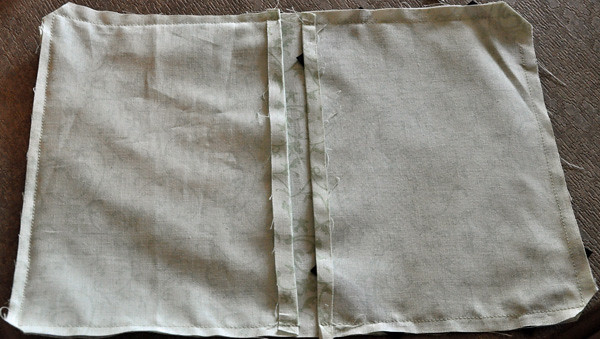
    Stitch carefully around the three pinned sides of the inside pockets.  Be sure you catch the elastic and all layers while stitching (this is why we need to pin it first).  Also be sure to leave the two pressed edges unstitched; otherwise you won’t be able to slip in the board!  Clip the corners and turn right side out.  You can slip in the board to be sure you push everything out completely.  Take out the board.
    Stitched, before turning right side out.


    Press.  I cannot emphasize how important this is!  If you are using mat board, you can press while the mat board inside, but do not have your iron hotter than wool, and don’t use steam.
    Ensure that your pocket comes all the way around.  I thought I had stitched it wrong,
    but in reality, it just needed a little persuading.  Press after you get to this step.


    With fine, sharp scissors, clip the piece of back fabric where it attaches to the inside pockets.  You will only need to clip it about ⅜”.  Pin or press so that the bottom edge is folded, and the raw edge is captured up inside of it.  If you look at the photo above, these are the small strips of fabric left in the unstitched area between the two halves, at the top and bottom.

    Take your felt or thick fabric and tuck it inside the area where you can see the back side of the outer fabric.  Trim it to fit.  We want this to reinforce the hinge area of the cover.  It should fit inside the edge of each pocket, up to the pressed area of the gap.  After trimming, pin it in place.  Be sure you pin the elastic down very securely, and have a little fold at the edge to tuck the raw edge of the elastic down over the folded and pressed portion of the pocket.
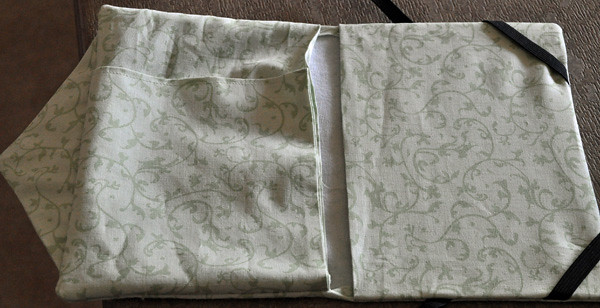
    In this view, the mat board has already been inserted as described below.

    Carefully slide in your mat board or plastic canvas.  It should be a pretty snug fit.  If you have any slack, push it to the edges and pin down the inner pockets very close to the edge.  If you have a lot of movement and it bothers you, you can turn it back inside out and stitch in a little closer.
     
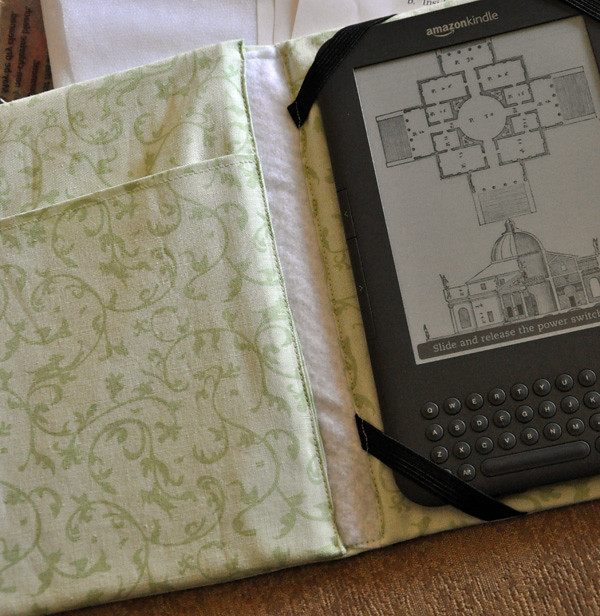
    Now for the moment of truth: check the fit of your Kindle.  If it fits, close the “book” and wrap the flap around the back.  Seriously – guys – do this with your Kindle inside, or it might not fit.  Mark the place where the flap needs to go to close snugly.
     
    Take out the fabric and sew on a button, snap, magnetic clasp onto the outer fabric – this is your last chance to do it without the board getting in your way!  *Note: due to the nature of the thing you are stitching, which is a pocket, this will suck.  Sorry.  (If you plan on closing the whole thing with an elastic band, you don’t have to worry about this part.)
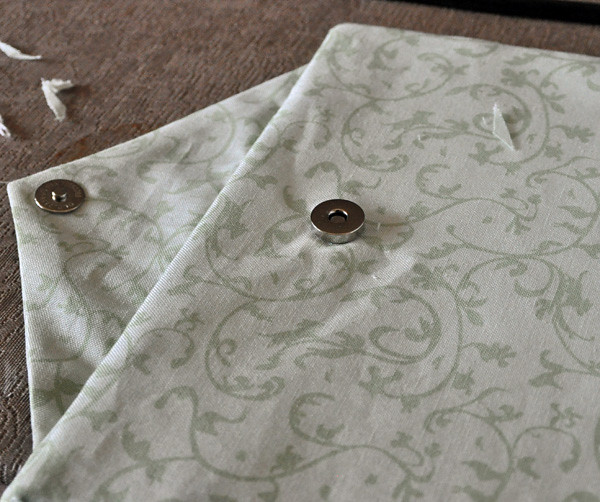
    The fact that I used a magnetic clasp made it not too bad, since I only had to cut two small slits in the fabric.
     
    Pin in the elastic, folded down, so that it will be caught when you topstitch in the next step.
    Using a zipper foot, topstitch through the inside pockets, through the felt, down to enclose the board.  If you don’t feel comfortable using a zipper foot or aren’t sure that you won’t stitch through the mat board or plastic canvas, you can always handstitch.
    I won't lie, this is the worst part of everything... but it goes by pretty quick.
     
    I would recommended hand stitching the little tiny flaps at the top and bottom of the felt-lined gap.  If you are a hoss with the machine, you can machine stitch it.  Kudos to your skills!  If you hate stitching altogether, just glue it down with some Fray-check or fabric glue.  Keep in mind, though, that this might stiffen the “hinge.”  I think, in the view above, I just tucked them under the felt, but I prefer for them to be on top of the felt, as I have done on the other two Kindle cases I have made.
    Per the "prancing pony" rule, the above mistakes do not technically count.
    I glued a button on to hide this.
    See?  Much better.
    In this view, you can see how a magnetic closure will keep the case open.
    The case isn't the most secure out there, but you could make some modifications to change that - such as another elastic band across the area between the screen and the keyboard, or a pocket sewn over the area where the keyboard is and the diagonal elastic on the top corners.  In a bookbag, though, it is just fine.  I have noticed that my Kindle is surprisingly sturdy, but I do want to keep it from being dinged up and scratched.

    UPDATE: my mom has had this case for several weeks now, and she said that she never has a problem with her device slipping out of it.  So maybe it's more secure than it looks!

    Monday, October 3, 2011

    Knitting Pattern: Pullip Anthropologie-Inspired Capelet

    Based on Julia Allen’s Anthropologie-inspired Capelet (Peony Knits designs), available on Ravelry.  For more information, see Julia Allen’s blog at http://peonyknits.blogspot.com.

    Pullip "Anthropologie-Inspired" Capelet


    A brooch used to close this made from an old earring would be a nice touch.
    You will need:
    • Size 1-US needles: Two DPN’s, straights, or a circular
    • Size 10 crochet cotton
      • Used for example: Aunt Lydia’s Classic Crochet Thread (100% mercerized cotton, 350 yd/320m per ball) color 0420 Cream
    • 4 very small stitch markers (best bet: tiny jewelry jumprings, available in the jewelry section of many craft stores)
    • Stitch holders (preferably 2 large safety pins)
    • A small button or pin, or other closure for the front
    • Scissors, ruler, & darning needle
    You will need to know:
    • How to knit and purl, and 1x1 rib
    • How to yo
    • How to place stitches on a holder and rejoin yarn
    • How to BO in 1x1 rib
    Gauge: 11 sts/per inch in stockinette stitch on size 1-US needles.  To ensure accurate sizing, be sure to check your gauge.

    Note:
    You will need to have a separate ball of yarn for working the sleeves and body, or two ends from the same ball.  Since I work from a ball of crochet thread, I wind about 10 yards of thread onto a bobbin (the small Susan Bates kind, in my favorite color – purple) to hold aside for the sleeves.  Cut the yarn, begin the sweater, and you won’t have to break the yarn to work the sleeves and then rejoin it to work the body.

    Capelet:
    CO 23 sts.  K in 1x1 rib for 3 rows.
    Place markers: k5, pm, k4, pm, k3, m1, k3, pm, k4, pm, k4.

    Begin raglan increases:
    Increase row: k2, *p to marker, yo, slip marker, p1, yo, rep from * to last 2 sts, k2.
    Next row: K all sts.

    Repeat the above two rows until you have 72 sts on the needles.

    Next row: slip 11 sts onto a spare DPN or stitch holder. 
    *Rejoin yarn and p 15, turn and k15, then work 3 rows of 1x1 ribbing and BO in rib.

    Slip 20 sts onto spare DPN or stitch holder.  Repeat above step (from *) for second sleeve.

    Rejoin all remaining sts onto one needle.  Continuing with unbroken yarn:
    K2, p to 1 st before gap, p2tog, p to 1 st before next gap, p2tog, p to last 2 sts, k2.
    K one row; p one row.
    Work 3 rows of 1x1 ribbing and BO in rib.
    Seam sleeves to underarm.  Weave in all ends.  Block if desired.
    Place a button or pin to close the front of the capelet.

    Wednesday, June 30, 2010

    Knitting Pattern: February Pullip Sweater

    This pattern has been TRIPLE checked for accuracy: I have made a green sweater, a blue/purple variegated sweater, and a brown sweater for a Dal with a needle one size smaller (for my wonderful Ravelry swap partner, Mimi).  It is very easy, provided you are an intermediate knitter with a familiarity working with crochet thread on size 1 needles.

    One final note: if you are lazy (like me) or not a big fan of using dolly-sized buttons (let's face it: who likes jamming a tiny little button into a tiny little hole?) you are welcome to use another closure, like a hook and eyelet (metal, not "velcro") and sew on faux buttons if you want to. 


    February Pullip Sweater
    Based on the February Lady sweater, available human-sized at Flint Knits.
    Lillian plays the part of "innocent schoolgirl" pretty convincingly.

    Materials:
    • Size 1-US needles (one circular, two DPNs with point protectors, whatever works for you)
    • One ball (you will need far less than a full ball) of size 10 crochet cotton
      • Used for example: Aunt Lydia’s Classic Crochet Cotton (100% mercerized cotton, 350 yd/ball) in 484 Myrtle Green
    • Three very small buttons
    • Scissors & darning needle

    You will need to know:
    • How to knit and purl
    • How to decrease: k2tog and ssk
    • How to yo
    • Basic familiarity with lace patterns: combining k2tog, ssk, and yo in the same rows (Note: working lace patterns, for me at least, requires an additional level of focus and concentration.  Try to work your lace patterns where you would be less distracted than usual, such as while your dear boyfriend watches a particularly boring game of golf on TV)
    • Garter stitch (knit every row)
    • The m1 increase
    Gauge: 11 sts/per inch in stockinette stitch on size 1-US needles.  To ensure accurate sizing, be sure to check your gauge.
     
    Note:
    You will need to have a separate ball of yarn for working the sleeves and body, or two ends from the same ball.  Since I usually work from a ball of crochet thread, where only one end is available, I wind about 30 yards of thread onto a bobbin (the small Susan Bates kind, in my favorite color – purple) to hold aside for the sleeves.  Cut a separate length of yarn, begin the sweater, and you won’t have to break the yarn to work the sleeves and then rejoin it to work the body.


    Gull lace pattern (see above site for source):
    Row 1: (K1, k2tog, yo, k1, yo, ssk, k1) across row.
    Rows 2 & 4: p all sts.
    Row 3: (k2tog, yo, k3, yo, ssk) across row.


    Sweater:
    CO 24 sts.  K 3 rows.
    Work increases according to the following chart.  The chart works like this, for row 1:
    K4, (m1, k1, m1), k3, (m1, k1, m1), k6, (m1, k1, m1), k3, (m1, k1, m1), k4.  The number in the first row is the starting stitch count (not the number of stitches you will end up with).  Always k one row after working an increase row.

    24 4 3 6 3 4 BH
    32 5 5 8 5 5
    40 6 7 10 7 6
    48 7 9 12 9 7 BH
    56 8 11 14 11 8
    64 9 13 16 13 9
    (Please pardon my quite rudimentary HTML skills.)

    For rows ending with the letters BH:
    After working the increase row, work a buttonhole row on the WS.  K2, yo, k2tog, k to end. 

    After you get to 72 sts total, end after one more row (WS).

    Next row: place 11 sts on holder, place 15 sts on spare DPN, place 20 sts on holder, place 15 sts on spare DPN, place 11 sts on holder.

    Sleeves:
    K2 rows. Only the last 14 sts are worked in pattern, so knit (or slip) every first stitch of every RS row and p every last st on every WS row.
    Begin gull lace pattern.  Work until the sleeves are nearly desired length (for me, this was just past elbows, and four repeats of the four-row pattern).  Work 3 rows of garter st: k next RS row and two more rows, and BO, leaving at least a 12-inch tail to sew seams.

    Resume body of sweater:
    K all sts onto one needle.  Do NOT work two stitches together under each underarm.  If you are concerned about gaps under the arms, you may close any hole when seaming the sleeves, or you may pull one stitch through the other and work them in the wrong order (k one st on the other side of the gap, k st before gap).  Work buttonhole row next for these sts.
    Work these sts in gull lace pattern as well, until the body is almost at the desired length.  K 3 rows in garter st again.  BO all sts.

    Sew sleeve seams using tails of yarn left from binding off.  Weave in all ends.  Attach buttons opposite buttonholes.  Block.